Services-led Product Growth (SPG)
The idea is that the promise of ai-enabled services or services-as-software is that you sell the outcome, but in order to achieve the outcome, you must understand the service you are doing, i.e. the work itself.
So in order to understand the work, you perform the service of working alongside the customer to solve the problems that achieve the outcome.
This Services-led Product approach is in contrast to a Product-led approach, where instead of learning about the customer such that they can use the product, the customer uses the product first before any learning has occurred.
The ideal end-state of a Services-led Product approach is a Product-led one, where you've understood and encoded the work so well into your product, with the right mix of domain generalizations and hack-ability plus progressive quarantining of customer-specific preferences in onboarding, such that a customer can start using the product without your service. Product-market fit, so to speak.
A Product-led end state is ideal because it can scale disproportionately to the time you put in11 May we ask for a second, though, what may happen if we obsolete ourselves from this service work? Surely there's parts of the discovery that don't need our time? yes, I believe there is, but I haven't gotten there yet.. Leverage, scale. Nice.
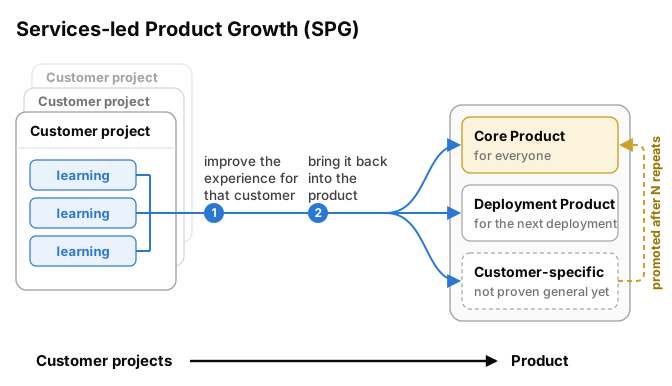
For a Services-led Product approach to progress towards that ideal end-state Product, which doesn't require the service, or requires increasingly less of it, each customer interaction/learning must do two things:
- improve the experience for that customer
- bring that learning back into the product and improve it for everyone else
Part two is critical because without it, you end up being a service forever. Maybe you enjoy projects and each project being different and want to continue that, then that's surely an option. Just no product.
But if the goal is to transition those projects into a product, the continuing of one-off projects where each one is radically different is a sign of one of two things:
- (A) you're not narrowing in on one particular problem/customer
- (B) you're not doing a good job at part two -- bringing it back into a product
So to bring it back into a product, I see there being three ways to do so:
- Core Product -- the golden stuff. what you probably think of when you "bring a learning back into the product". this makes the core experience better for everyone that came before and after because it's a shared data/workflow problem.
- Deployment Product -- makes the service of deploying for the next customer easier/faster/cheaper. still important because the offering is the service + product package so gains here are valuable gains in the overall value.
- Customer-specific -- unfortunately not every learning can scale across the domain and each customer's needs. that's what this bucket is for. BUT that doesn't mean this may never scale, it's just not proven to be generalizable yet; your understanding of your customer, and who your customer is, may change - so this can still be promoted into Core Product should it become repeated at N=sufficient.
I write this because this is what I'm trying to do. And maybe you are too. The end.